
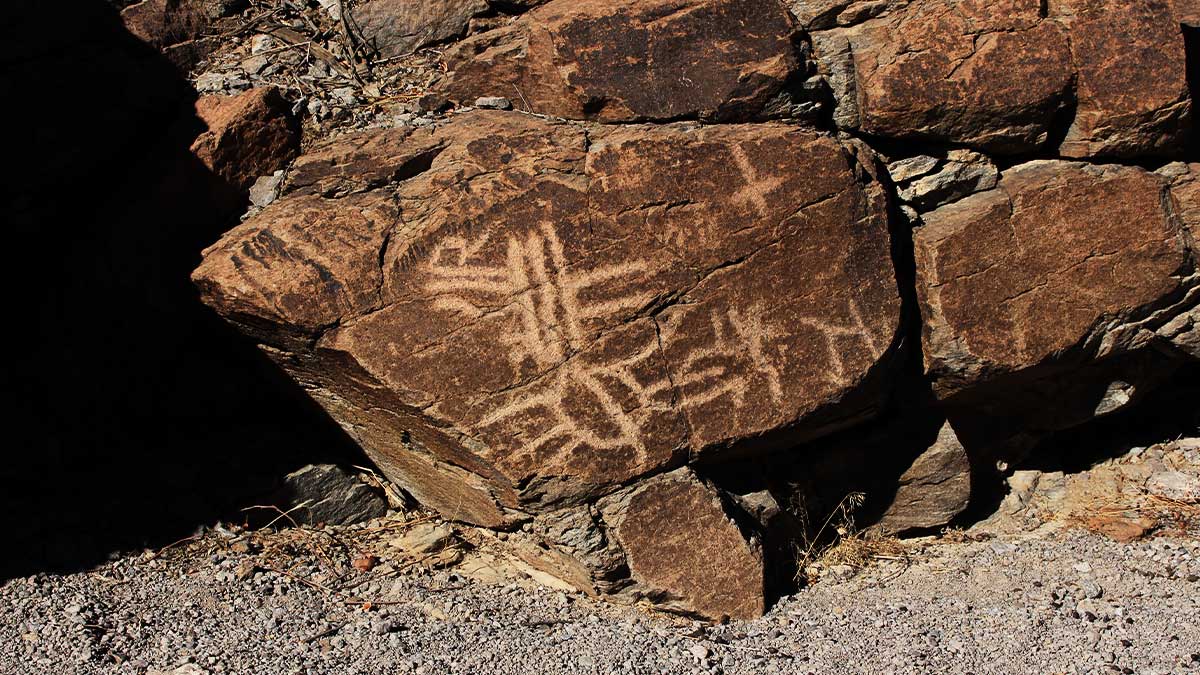
On the southern edge of the Las Vegas Valley is a landscape that feels completely removed from the Strip: Sloan Canyon National Conservation Area.
Covering more than 48,000 acres along the edge of Henderson, Sloan Canyon is a world of dark volcanic rock, desert washes, rugged mountains, and centuries of human history carved into stone.
At the center of it all is the Sloan Canyon Petroglyph Trail, where hundreds of rock-writing panels are scattered through a narrow volcanic canyon.
It is one of those places that reminds you just how quickly Las Vegas can disappear behind you.
We originally came here for the hike, but the petroglyphs, strange rock formations, quietness, and feeling of walking through such an old landscape ended up making Sloan Canyon much more memorable than we expected.
Temporary access change through November 11, 2026: Nawghaw Poa Road and the original parking area are closed while the Bureau of Land Management constructs the new Sloan Canyon National Conservation Area Visitor Contact Station. The Petroglyph Canyon Trail and 101 Trail have been temporarily rerouted, with parking moved near Democracy Drive. The current Petroglyph Trail hike is approximately 5.5 miles round trip. Before leaving, check the current BLM Sloan Canyon information.
From Urban Streets to Canyon Peaks
STARTING YOUR SLOAN CANYON JOURNEY
One of the biggest things to know before heading to the Sloan Canyon Petroglyph Trail is that the approach has changed since our original hike.
When we first visited, we followed Nawghaw Poa Road toward the original parking area and Visitor Contact Station.
That is not how you access the trail right now.
A few days ago, I walked back up to Sloan Canyon to see the construction situation for myself. Nawghaw Poa Road was gated off with a BLM construction notice, while signs at the temporary trail access directed hikers to park on the south side of Democracy Drive.
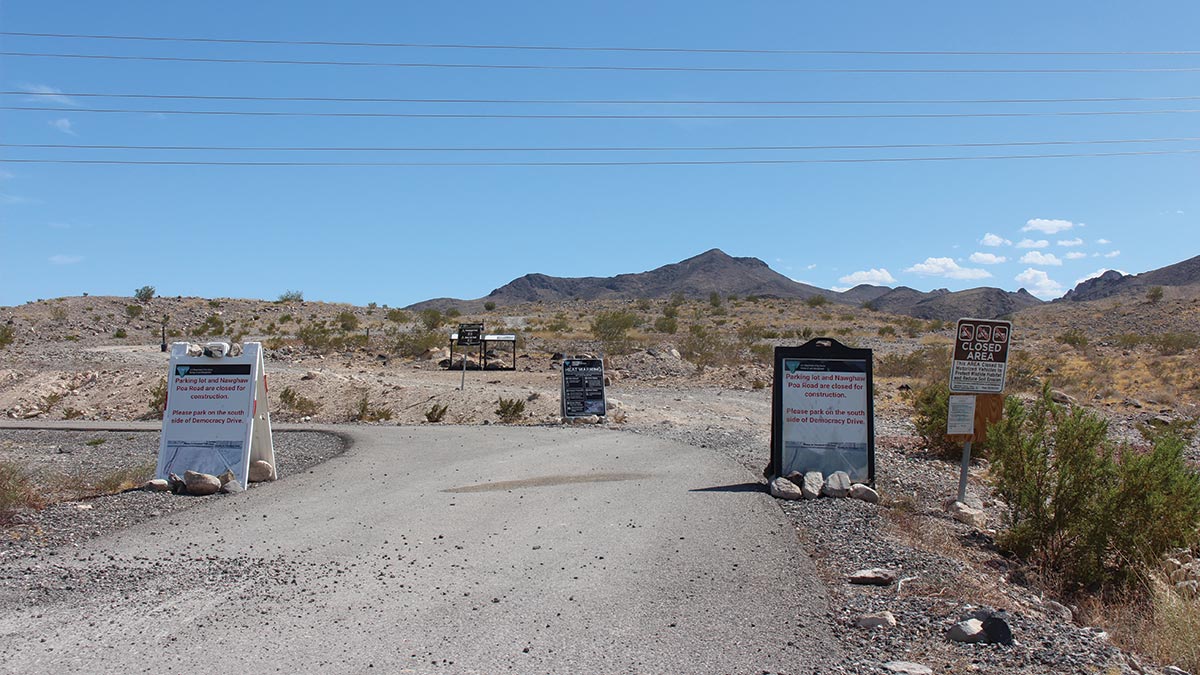

BLM says the road and original parking area are scheduled to remain closed through November 11, 2026. During construction, the Petroglyph Canyon Trail and 101 Trail are rerouted from the Democracy Drive area.
The temporary route also makes the Petroglyph hike longer, at approximately 5.5 miles round trip.
That means our original map below is useful for understanding the canyon itself, but it should not be treated as the current construction-access map.

Our original route was approximately 4.4 miles. The temporary construction reroute is currently about 5.5 miles round trip.
Illustrated by Yahor Buiniakou
The Sloan Canyon Entrance Is Changing
The construction is actually part of a larger transformation happening at the edge of Sloan Canyon.
BLM is building a permanent Sloan Canyon National Conservation Area Visitor Contact Station on federal land.
At the same time, the City of Henderson is separately planning the Sloan Canyon Gateway Park near Democracy Drive and Nawghaw Poa Road.
The roughly 21-acre city project is intended to create a transition between Henderson neighborhoods and the protected conservation area. Plans include trails, interpretive experiences, public art, shaded seating, parking, a restroom facility, a play area, and restored desert landscaping.
The Gateway Park and the BLM Visitor Contact Station are two different projects.
Together, though, they are going to make the approach to Sloan Canyon look very different from what we saw during our original hike.
On that trip, we passed a small mobile office labeled the “Visitor Contact Station.”
“At first glance, I thought the ‘Visitor Contact Station’ sign meant something alien-related, like it was a site for UFO sightings or something mysterious. But in reality, it served as a place for hikers to check in and get information before starting the trail.”

The photos throughout this story document the hike as we experienced it. Anyone visiting during the current construction should use BLM’s latest reroute information rather than relying exclusively on our original approach.
Once you get beyond the neighborhoods and construction, though, Sloan Canyon still becomes desert very quickly.


The soft crunch of gravel, warm desert air, and mountains rising ahead made the city feel much farther away than it actually was.
That transition reminded me of exploring Death Valley, where open space and silence become part of the experience almost immediately.
Into the Volcanic Heart of Sloan Canyon
The traditional route eventually leads into the 100 Trail, better known as the Sloan Canyon Petroglyph Trail.
One of the first things that stood out to us was the rock.
This is not the bright sandstone you see at Red Rock Canyon.
Sloan Canyon is much darker.

The North McCullough Wilderness within Sloan Canyon is volcanic in origin, with evidence of old lava flows, ash deposits, and other volcanic formations visible throughout the area.
Some of the rocks looked almost deliberately stacked.
They reminded us of the strange formations we have seen on trips to Bryce Canyon, even though the geology and appearance are completely different.


Deep washes and jagged ridges cut across the landscape, with the terrain shifting constantly between wider desert views and tighter canyon sections.
It has a very different personality from the huge sandstone walls around Zion National Park.
Sloan feels rougher, darker, and more understated.
The farther we went, the more interesting it became.
The Sloan Canyon Petroglyph Trail
WALKING AMONG CENTURIES OF ROCK WRITING
On the route we hiked, we eventually reached the junction between the Petroglyph Trail and Cowboy Trail.

From there, the landscape began closing in.
The walls became tighter and the dark volcanic surfaces started revealing the reason most people come here.


At first, the petroglyphs were surprisingly easy to miss.
Then we found one.
Then another.
And once we knew what we were looking for, we kept slowing down to scan the surrounding rocks.
BLM says the Sloan Canyon Petroglyph Site contains more than 300 rock-writing panels with nearly 1,700 individual designs.
The designs represent Native cultures spanning from the Archaic through the historic era, which means this canyon preserves evidence of human activity across an enormous period of time.
That is also why I would not try to assign every carving to one specific culture or claim we know exactly what every design meant.
“Seeing these petroglyphs up close felt surreal. I imagined the hands that carved them, the stories they may have told, and the people who once walked these same paths. The quietness of the canyon made it easy to reflect, and I found myself standing still, taking in the weight of the history around us.”
Some designs look recognizable.
There are shapes that resemble animals or people, along with spirals, lines, circles, and geometric patterns.
Others are much harder to interpret.
Part of respecting the petroglyphs is being comfortable with the fact that we do not know the exact meaning of every symbol.
Instead of turning them into our own story, sometimes it is better just to stand there and appreciate that they survived long enough for us to see them.
For more context on the Indigenous and archaeological history of Southern Nevada, The Lost City Museum is one of the best related trips on Everyday.Vegas.


Look Closely, But Don’t Touch
Seeing the carvings from only a few feet away makes it tempting to get even closer.
Don’t.
BLM asks visitors to remain on the trail near the rock-writing sites, not climb around the panels, and never touch the petroglyphs. Oils from your skin can damage the rock surface, while rubbings and new markings can permanently alter something that has survived for centuries.
Take photos, look closely, and leave the rock exactly as you found it.

There is plenty to look at beyond the rocks too.
Creosote, cacti, and other desert plants survive in an environment that can look completely unforgiving during summer. For a totally different way to appreciate Mojave Desert plants, Cactus Joe’s is one of our favorite local stops.
The Cowboy Trail
A WILDER RETURN THROUGH THE DESERT
On our original hike, we used the Cowboy Trail as part of the return.
Almost immediately, the experience changed.
The enclosed Petroglyph Canyon gave way to wider views, scattered shrubs, prickly pear, and open desert.
The scenery reminded me a little more of the openness around Valley of Fire, although Sloan’s dark volcanic landscape gives it a completely different character.

This was also where we started paying more attention to wildlife.
We saw rabbits and lizards moving around the trail and kept hoping a desert tortoise might eventually appear.
It never did.
“The Cowboy Trail felt quieter and wilder. I caught glimpses of movement, a rabbit here, a lizard there, and paused more than once hoping to spot a desert tortoise. The openness of the trail was a stark contrast to Petroglyph Canyon, but both had their own kind of beauty.”
Even without a tortoise sighting, the Cowboy Trail was a good reminder that the landscape is not empty just because wildlife is difficult to spot.
The rocks remained dramatic too, with huge boulders, narrow ridges, and formations that looked completely different depending on the angle of the sun.
For a much more technical canyon experience, the ropes, dry falls, and boulder scrambling on the Gold Strike Hot Springs Trail take Southern Nevada hiking to another level.
Sloan Canyon Is Much Bigger Than the Petroglyph Trail
The petroglyphs are the main reason many people visit, but they represent only one small part of Sloan Canyon National Conservation Area.
The conservation area covers approximately 48,438 acres, including the 14,790-acre North McCullough Wilderness.
That means there are volcanic ridges, washes, remote trails, and huge sections of open Mojave Desert that most people hiking the Petroglyph Trail never experience.

The scale is especially strange because Henderson is so close.
At certain points you can turn around and see neighborhoods or the Las Vegas Valley in the distance, while everything immediately around you still feels like open desert.
If you want to see the complete opposite nearby, Lake Las Vegas is developed, landscaped, and centered around water instead of volcanic wilderness.
What to Know Before Hiking Sloan Canyon
The Sloan Canyon Petroglyph Trail is not an extreme technical hike, but this is still exposed Mojave Desert and the temporary construction route has made the outing longer.
- Use the current entrance: Nawghaw Poa Road and the original parking area are temporarily closed through November 11, 2026. Current trail access is from the Democracy Drive area.
- Plan for about 5.5 miles: The construction reroute has increased the current Petroglyph Trail hike to approximately 5.5 miles round trip. Our original illustrated map shows the route we hiked before the reroute.
- Check the hours: Petroglyph Canyon is a day-use area with seasonal hours. BLM currently lists shorter summer hours and longer fall-through-spring hours, so check the current schedule before driving out.
- Bring serious water: There is almost no shade. BLM’s summer heat guidance recommends about one gallon, or four liters, of water per person per day, with even more potentially needed during strenuous activity.
- There are no restrooms at the temporary Petroglyph Trail trailhead: BLM recommends using facilities elsewhere before beginning the 5.5-mile hike.
- Summer heat is no joke: Temperatures in Sloan Canyon can exceed 110°F, and the dark rock inside Petroglyph Canyon can radiate even more heat.
- Leave dogs at home for this route: Dogs are prohibited on the Petroglyph Trail and inside Petroglyph Canyon. Service animals are permitted.
- Do not touch the petroglyphs: Stay on the trail around the cultural site, avoid climbing near the panels, and never make rubbings or add markings.
- Watch where you step: Sloan Canyon is rattlesnake habitat. Pay attention around brush, rocks, and crevices, especially during warmer weather.
- Don’t count on your phone: Cell service can become poor or unavailable inside Petroglyph Canyon.
More Nevada Landscapes Beyond Sloan Canyon
One of my favorite things about living in Southern Nevada is how quickly the environment can completely change.
The forests of Mt. Charleston replace dark volcanic rock with pine trees, alpine terrain, and much cooler temperatures.
Closer to the valley floor, Clark County Wetlands Park shows another side of the desert, where water creates one of the greenest natural environments around Las Vegas.
Why Sloan Canyon Is Worth the Hike
Sloan Canyon is not the flashiest outdoor destination around Las Vegas.
There are no giant waterfalls, bright red cliffs, alpine forests, or developed scenic overlooks.
What makes the Sloan Canyon Petroglyph Trail memorable is how much is hidden inside such an understated landscape.
You get volcanic mountains, open Mojave Desert, views back toward Las Vegas, wildlife, strange rock formations, and one of Southern Nevada’s most significant collections of Native rock writing.
And it is all sitting right at the edge of Henderson.

The entrance may be changing.
A new BLM Visitor Contact Station is being built. Henderson is planning the Sloan Canyon Gateway Park. The current trail has been temporarily rerouted.
But once you get into the canyon, the part that makes Sloan special is still there.
The dark volcanic rock.
The silence.
The petroglyphs.
And that strange feeling of turning around toward Las Vegas and realizing the city is right there, even though it suddenly feels very far away.
For another rough desert adventure near the water, our trip to Kingman Wash offers a completely different way to explore the landscape around Southern Nevada.
You can also find more places to get outside in our Everyday.Vegas Trips coverage.
Frequently Asked Questions
Is there an entrance fee for Sloan Canyon?
No. Sloan Canyon National Conservation Area is generally free to visit. Certain organized group activities, commercial uses, or special events may require authorization or a Special Recreation Permit from the Bureau of Land Management.
How difficult is the Sloan Canyon Petroglyph Trail?
The Petroglyph Trail is a rugged desert hike with uneven terrain, loose rocks, elevation changes, and areas that may require careful scrambling. The temporary rerouted hike is approximately 5.5 miles, and the trail is not considered accessible for visitors with limited mobility.
What is the best time to visit Sloan Canyon?
The most comfortable time to visit is generally from fall through spring, particularly during the morning. Summer temperatures can exceed 110 degrees, while the dark volcanic rock inside Petroglyph Canyon can make conditions feel even hotter.
Are dogs allowed at Sloan Canyon?
Dogs are prohibited on the Petroglyph Trail and inside Petroglyph Canyon to protect the area’s cultural and natural resources. Service animals are permitted. Pet rules may differ on other trails within the larger conservation area, so visitors should confirm the restrictions for their chosen route.
Are the Sloan Canyon petroglyphs currently accessible?
Yes, but access has been temporarily rerouted. Nawghaw Poa Road and its original parking area are closed through November 11, 2026, while a new visitor contact station is constructed. Visitors currently access the rerouted Petroglyph Canyon and 101 trails from parking near Democracy Drive.
Address:
Nawghaw
Poa Road
Henderson, NV, 89052
Hours:
Monday - Friday: 8 AM - 4:30 PM
Saturday: 8 AM - 4:30 PM
Sunday: 8 AM - 4:30 PM
Phone:
(702) 515-5000








Comments are closed.